Google Docs keeps eating my posts before I can publish them......so reconstruction is the order of the evening.......maybe reconstruction is the theme of this whole blog. . . .
What I wrote to go up today was about Lent, and I do not remember any of it . . . yes, Ash Wednesday was a week ago, but I only read Kathleen Norris' "Detachment" chapter last night. During a crisis in her life, she was staying with Benedictines near a hospital and came to a meal to find the table decorated for Mardi Gras. "We [one of the sisters] talked about Lent," Kathleen wrote, and she told me that for most of her life she had considered it only in punitive terms, as a time of self-denial. "Now," she said, "I still fast, but my reasons for fasting have changed." She hoped to recover Lent as an aspect of spring itself, a time of waiting, but also of burgeoning hopes.
And so the chord struck with "When the Heart Waits," which I have had to put down. Having read it, the sense is, "OK, I get it. . . ." But the waiting continues and the three-day weekend looming. So, I thought of observing Lent, at least somewhat. Being conscious of a kind of fasting, of giving up some things in order to think about others.
And that may take me back to "When the Heart Waits" . . .
Wednesday, February 28, 2007

Tuesday, February 27, 2007
Echoes
"When you feel like that, you often meet what you feel," said Leopold Bloom.
Kidd quotes Rollo May: "In human beings courage is necessary to make being and becoming possible. It takes courage to let go and yield yourself to the changes that take place in the chrysalis. It takes courage to become who you are."
A short while earlier, reading Anne Perry, Lady Vespasia Cumming-Gould: "She was afraid of what the answer would be, but she had always believed courage to be the cornerstone of all virtues. Without it integrity perished; even love could not survive, because love was risk, and somewhere, at some time or place, it would always hurt."
Reading When the Heart Waits, echoes sound often. This shows it's is the right time to get into this work; but sticking with it. . . . it will take courage.
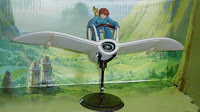
Like my ally, Nausicaa.

Kidd quotes Rollo May: "In human beings courage is necessary to make being and becoming possible. It takes courage to let go and yield yourself to the changes that take place in the chrysalis. It takes courage to become who you are."
A short while earlier, reading Anne Perry, Lady Vespasia Cumming-Gould: "She was afraid of what the answer would be, but she had always believed courage to be the cornerstone of all virtues. Without it integrity perished; even love could not survive, because love was risk, and somewhere, at some time or place, it would always hurt."
Reading When the Heart Waits, echoes sound often. This shows it's is the right time to get into this work; but sticking with it. . . . it will take courage.
Like my ally, Nausicaa.

Sue and Kathleen
When I finished When the Heart Waits, I dipped into it for a few days. Then, I sat at the little round table where I read and looked at the three books stacked there for many days now. Kathleen Norris, Amazing Grace: A Vocabulary of Faith, that I have had for many years without reading much of it. Caroline Myss, Sacred Contracts: Awakening Your Divine Potential, given me by another friend in 2002 and not much used because one needs a pencil and paper to do the work. And a comic murder mystery.
I picked up Amazing Grace, a dictionary-format book, with about two pages per entry. First, I chose "Detachment," then "Prayer," then "Bible," then "Anger," then "Seeking."
The first one I chose, "Detachment," was written as Lent began . . . and I realized Lent was a week old now, but that I could use it to work with the "waiting" I am doing (and the weight I have to shed . . . had been doing focused positive thinking and believed I must be 147 lbs., with 7 to drop to goal; lo and behold, I weigh 157! It is time for Lent!)
One of the surprising things was that things Norris said about prayer, for example, were just what Kidd was saying. I re-stumble on the same concepts, and know their truth.
The bad news is that living them is not as easy as it seems while sitting in the chair at the round table reading about them.
Stay tuned!
I picked up Amazing Grace, a dictionary-format book, with about two pages per entry. First, I chose "Detachment," then "Prayer," then "Bible," then "Anger," then "Seeking."
The first one I chose, "Detachment," was written as Lent began . . . and I realized Lent was a week old now, but that I could use it to work with the "waiting" I am doing (and the weight I have to shed . . . had been doing focused positive thinking and believed I must be 147 lbs., with 7 to drop to goal; lo and behold, I weigh 157! It is time for Lent!)
One of the surprising things was that things Norris said about prayer, for example, were just what Kidd was saying. I re-stumble on the same concepts, and know their truth.
The bad news is that living them is not as easy as it seems while sitting in the chair at the round table reading about them.
Stay tuned!
A new book
My good friend sent me a book quite unexpectedly. When the Heart Waits, by Sue Monk Kidd, from 1990. Seventeen years ago this book came out! And it is about mid-life crisis and I am well into Third Age. Hmmm . . . but I dipped into it, because my good friend is never wrong. I surfaced at page 31, and did not pick up my constant-companion-murder-mystery until I finished the book a week later. How well this book fits me!
It makes my long (nearly three years now) wait and my complaints about darkness, and nothing happening, and vital-life-in-hiding take on meaning. I always loved St. John of the Cross and his dark night of the soul, and wonder why I did not keep that book. Suddenly my long sojourn in what I have been calling "a small, dark place" made sense. Kidd quotes Eliot, "Four Quartets"; I did my B.A. thesis on this.
I found meaning. I found direction. I settled down. I felt calm. I started opening the book to random pages. I say "thank you" to my good friend.
Onward.
It makes my long (nearly three years now) wait and my complaints about darkness, and nothing happening, and vital-life-in-hiding take on meaning. I always loved St. John of the Cross and his dark night of the soul, and wonder why I did not keep that book. Suddenly my long sojourn in what I have been calling "a small, dark place" made sense. Kidd quotes Eliot, "Four Quartets"; I did my B.A. thesis on this.
I found meaning. I found direction. I settled down. I felt calm. I started opening the book to random pages. I say "thank you" to my good friend.
Onward.
Subscribe to:
Posts (Atom)